WHAT PROPERTY MAY BE TRANSFERRED AND WHAT PROPERTY CAN NOT BE TRANSFERRED
Transfer of Property Act, 1882
Dr. Tanmoy Mukherji
Advocate
WHAT PROPERTY MAY BE TRANSFERRED AND WHAT PROPERTY CAN NOT BE TRANSFERRED (Section – 6 of the Transfer of Property Act, 1882)-
TANMOY MUKHERJI
Advocate
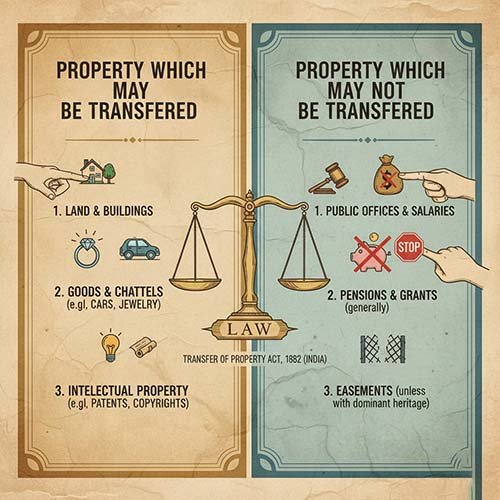
Section 6 of the Transfer of Property Act lays down that property of any kind may be transferred except as provided under the Act or any other Law for the time being in force. The words 'property of any kind' indicates that Transferability is the general rule and the right to property includes the right to transfer the property to another person. Property of any kind excludes from its purview the future property. A transfer of future property can only operate as a contract, which may be specifically performed when the property comes into existence.
What property may be Transferred and what property cannot be Transferred-
Section 6 Clause (a) to (i) of the T.P. Act lay down the provisions relating to what property may be transferred and what property cannot be transferred.
It runs as follows-
Property of any kind may be transferred, except as otherwise provided by this Act or by any other law for the time being in force-
(a) The chance of an heir-apparent succeeding to an estate, the chance of a relation obtaining a legacy on the death of a kinsman, or any other mere possibility of a like nature, cannot be transferred.
(b) A mere right of re-entry for breach of a condition subsequent cannot be transferred to anyone except the owner of the property affected thereby.
(c) An easement cannot be transferred apart from the dominant heritage.
(d) An interest in property restricted in its enjoyment to the owner personally cannot be transferred by him.
(dd) A right to future maintenance, in whatsoever manner arising, secured or determined, cannot be transferred.
(e) A mere right to sue cannot be transferred.
(f) A public office cannot be transferred, nor can the salary of a public officer, whether before or after it has become payable.
(g) Stipends allowed to military, naval, air force and civil pensioners of the Government and political pensions cannot be transferred.
(h) No transfer can be made (1) in so far as it is opposed to the nature of the interest affected thereby; or (2) for an unlawful object or consideration within the meaning of Section 23 of the Indian Contract Act, 1872 (9 of 18 72); or (3) to a person legally disqualified to be transferee.
(i) Nothing in this section shall be deemed to authorize a tenant having an untransferable right of occupancy, the farmer of an estate in respect of which default has been made in paying revenue, or the lessee of an estate under the management of a Court of Wards, to assign his interest as such tenant, farmer or lessee.
What property may be Transferred?
Right to property includes the right to transfer property or interest, absolute or limited in the property. Property of any kind may be transferred except those enshrined in Clause (a) (i) of Section 6 of the Transfer of Property Act and any other law for the time being in force may declare such property as not transferable.
What property cannot be Transferred?
Section 6 of the Transfer of Property Act provides for the general rules that all kinds of property are alienable/transferrable. However, certain exceptions are provided under Clauses (a) to (i). In other words, the following properties, which are contained in clauses (a) to (i) of Section 6 of the T.P.Act are not transferable/alienable-
(1)Spes Successionis [Section 6(a)].
(2) Mere Right of Re-entry [Section 6(b)].
(3) Easement [Section 6(c)].
(4) Personally restricted interest [Section 6(d)].
(5) Right to future maintenance [Section 6(dd)].
(6) A mere right to sue [Section 6(e)].
(7) Public offices [Section 6(f)].
(8) Stipends and Pensions [Section 6(g)].
(9) Unlawful Transfers [Section 6(h)]; and
(10) Others or certain other occasions [Section 6(i)].
(1) Spes Successionis (Section 6(a)
- The expression 'Spes Succcessionis' means "mere chance or hope of succession". The right of a person to inherit to another in future is a mere chance, which may or may not happen and hence, it cannot be transferred. In other words, mere hope to get the property of another cannot be transferred.
-In England transfer of spes successionis, is ineffective. However, an assignment is valid on equitable grounds provided, it is for valuable consideration. In India, spes successionis is a nullity, (null and void).
Illustration-
(1) A, a Hindu owning separate property, dies leaving a widow B and a brother C. C has only a bare chance of succession (Spes Successionis) and this chance of succeeding to the property cannot be transferred. C's succession to the estate is dependent upon two factors, i.e. (i) his surviving the widow B and (ii) B leaving the property intact.
(2) A dies leaving two widows and a reversionary heir B. The widows set up a will, which authorized them to adopt a son. B filed a suit challenging the validity of the will and in order to raise money for the litigation transferred his share to C. The Court set aside the will. On the death of the widows B entered possession of A's estate. C sued B but C's suit was dismissed as B at the time of the transfer, had spes successionis in A's estate and, therefore, could not transfer it.
(3) A expecting that C, his aunt, who had no issues, would bequeath her house worth Rs.50000, transfers it to B. The transfer is invalid.
Reference Cases-
Amrit Narayana vs. Gaya Singh (1918 L.R. 45 IA 35)-
In this case the guardian of a minor reversioner entered into a compromise with the female holder by which the properties were relinquished in favour of other relatives. In a suit by the reversioner for possession of properties after the death of the female holder, it was held that the Hindu reversioner has no present interest in the property so long as the female holder is alive. His right becomes concrete only when she dies, until then it is a mere chance of succession. Hence the compromise was void.
Anand Mohan vs. Gour Mohan (50 Cal. 929 PC)-
In this case a Hindu widow was in possession of property. If she died B would have taken the property as a reversionary heir. Even before A's death B entered into a contract with C to sell the property to him and C agreed to put in possession whenever A dies. Subsequently A died. C sued for specific performance of contract. The Privy Council held that the contract is for transfer of a spes successionis and so such transaction is not valid. This suit was dismissed.
(2) Mere right of re-entry [Section 6(b)]-
Section 6(b) provides that a mere right of re-entry for breach of a condition subsequent cannot be transferred to any one, except the owner of the property affected thereby.
By a mere right of re-entry is meant a right to resume possession of land, which has been given to another person for a certain time. This right of re-entry is usually inserted in leases empowering the lessor to re-enter upon the demised premises if the rent is in arrear for a certain period or if there is a breach of covenants in the lease. In other words, in a contract of lease, the lessor has a right of re-entry. A mere right of re-entry cannot be transferred. The lessor alone can enjoy this right and he cannot transfer it to any other except lessee who is affected thereby.
Illustration-
A grants a lease of a plot of land to B with a condition that if B shall build upon it, he would re-enter. A transfers C his right of re-centering in case of breach of the covenant not to build. The transfer is invalid for two reasons, one, the right is a personal license and not transferable, second, the transferee could only use it for the purposes of a suit to enforce the right without acquiring any right in the property. But if A transfers the whole of his interest in the property, i.e. ownership along with the right of re-entry to C, the transfer shall be valid being a legal incident of the property.
Reference Cases-
Vaguram vs. Rangayyanagar (31 All 304) –
In this case the lessee committed a breach of the covenant to pay rent and incurred forfeiture. Thereupon, the lessor leased the lands to another with a right to take possession of the land from the tenant in default. It was held that the transfer was not invalid by reason of Section 6(b) for the assignment was not of a right of re-entry but of the reversion following upon the forfeiture.
(3) Easement [Section (6c)]-
The term 'Easement' means "right over the property of another i.e. right in re aliena". In Mohammedan Law, they are called 'Neighbors' rights.
Section 6(c) provides that an easement cannot be transferred apart from the dominant heritage. An easement is an incident of the ownership of the dominant heritage and passes with it. Therefore, it cannot be separated from the dominant heritage and transferred separately.
An easement includes a right not arising from contract, by which one person is entitled to remove and appropriate for his own profit any part of the soil belonging to another or anything growing in, or attached to or subsisting upon, the land of another. An easement is a right. It cannot be separated from the property on which easement exists. Therefore, only easement cannot be transferred.
Illustrations-
(1) A has an easementary right to get the water from the well of B. A cannot transfer this easementary right to any third person.
(2) A, the owner of a house X, has a right of way over an adjoining plot of land belonging to B. A transfers this right of way to C. The transfer is a transfer of easement and therefore invalid. But if A transfers the house itself, the easement passes on to C on such transfer.
-It must be noted that the section refers to the transfer of an existing easement and not to the creation of an easement. The creation of an easement is not transfer of property. The section has also no application to release of an easement.
(4) Personally restricted interest [Section 6(d)]:
Certain interests in a property are to be enjoyed by the owner alone and cannot be transferred to any one. A person having right to a property can transfer the same either subject to a restriction or without restriction. Where property is transferred subject to a restriction the transferee is supposed not to act contrary to the restriction. Thus, if property is transferred to the transferee with a restriction that it is to be enjoyed by him personally, he shall have no right to transfer such a property and if he transfers the property in violation of the restriction, the transfer shall be void under this clause.
E.g.: A priest in a temple or a house is lent to a person for his personal use; he cannot transfer his right of enjoyment to another.
Illustration-
A transfers his house to B for solemnization of marriage of B's daughter. After the marriage is over B allows C to use the house for his residence and pay rent for use and occupation of the house to B. Here transfer of house of B to C is void under this clause because it was given to him for his personal use, i.e. solemnization of his daughter's marriage. The object of the rule is that if it were allowed to be transferred it might defeat the very purpose underlying the restriction and it would be manifestly inconsistent with the presumed intention of its founder. Property may be restricted to personal enjoyment either by law or custom or the conditions of grant.
(5) Right to Future Maintenance [Section 6(dd)]-
A right to future maintenance is solely for the personal benefit of the person to whom it is granted and hence, cannot be transferred. This Clause (dd to Section 6) was added by the Amendment Act of 1929. Before the insertion of this clause in 1929, there was a conflict of opinion whether the right to future maintenance when it was fixed by a decree was transferable.
It was held in Madras that it was (Ranee Annapurni vs. Swaminath, 34 Mad. 7) and in Calcutta that it was not (Asad Ali vs. Haider Ali, 38 Cal. 13). The amendment supersedes the Madras decision. The result is that the assignment of a decree for maintenance is valid if the maintenance has already become due but as to future maintenance it is not valid. Arrears of maintenance, therefore, can be assigned.
(6) A mere right to sue [Section 6(e)]-
Clause (e) of Section 6 provides that a mere right to sue cannot be transferred. To 'sue' means to make a legal claim or to take legal proceedings against any person. It does not necessarily imply institution of a suit by means of a plaint, such as is referred to in the Code of Civil Procedure. It rather implies the taking of any legal proceedings in matters of any kind, e.g. right to sue for a breach of a contract or tort. Thus a mere right to sue of whatever nature cannot be transferred in law. It is said that a stranger to a contract (suit) cannot sue. Only parties to the suit alone can sue and be sued since it is a personal right. However, there are certain exceptions to this rule.
Illustration-
A carries on business of transporting goods from one place to another. He transfers to 'B' the right to sue for damages for breach of contract relating to the business. Here transfer of the right to sue in favour of B is affected by this clause because the right to sue is intimately connected with the business and is an important item of its assets. But if A assigns his business to B, he will get the right to sue automatically. It is not transfer of a mere right to sue. A claim for compensation for use and occupation against a tenant holding over is a mere right to sue and cannot, therefore, be transferred.
(7)Public offices [Section 6(f)]-
Public offices or Salary of public officer cannot be transferred. The prohibition is imposed on the basis of the public policy. The expression 'public office' has not been defined in the Act. A public office is a position which has a public duty attached to it. It does not matter whether the person holding the office receives any fee or salary for the performance of such duty or not or whether he receives it from Government or otherwise.
(8) Stipends and Pensions [Section 6(g)]-
Stipends and pensions allowed to Army, Navy, Air force and Civil, Government and Political pensioners cannot be transferred. Pension means a periodical allowance or stipends granted not in respect of any right to office but on account of past services on particular merit. Thus, a bonus or a reward is not pension. An allowance granted for other considerations is not within the prohibition and can be transferred. A pension is also exempt from attachment under Section 60 (g) of the Code of Civil Procedure, 1908. Similarly, scholarships, Medals, Rewards etc. cannot be transferred.
(9) Unlawful Transfers [Section 6(h)]-
Unlawful Transfers provides 'No transfer can be made (1) in so far as it is opposed to the nature of interest affected thereby, or (2) for an unlawful object or consideration within the meaning of Section 23 of the Indian Contract Act, 1872, or (3) to a person legally disqualified to be a transferee.
- A transfer of property in consideration of doing a murder is void. Similarly, a transfer of property whose object or consideration is 'future illicit cohabitation' is void. A transfer of property, for 'past illicit cohabitation' is also bad in law and therefore is void.
Object-
The object of this clause is based on public policy and public welfare.
(10) Others or Certain other occasions [Section 6(i)]-
Section 6 Clause (i) explains certain other occasions in which transfers are not permitted. They are—
(1) A tenant, having untransferable right of occupancy, cannot transfer his right of tenancy.
(2) A farmer of an estate in respect of which default has been made, in paying revenue is not permitted to transfer the estate.
(3) A lessee of an estate, under the management of a Court of Wards, is not allowed to transfer his interest.

we believe in a holistic approach to legal education building not just lawyers, but socially conscious leaders of tomorrow.
