UT RES MAGIS VALEAT QUAM PEREAT
TANMOY MUKHERJI INSTITUTE OF JURIDICAL SCIENCE
Dr. Tanmoy Mukherji
Advocate
UT RES MAGIS VALEAT QUAM PEREAT-
Tanmoy Mukherji
Advocate
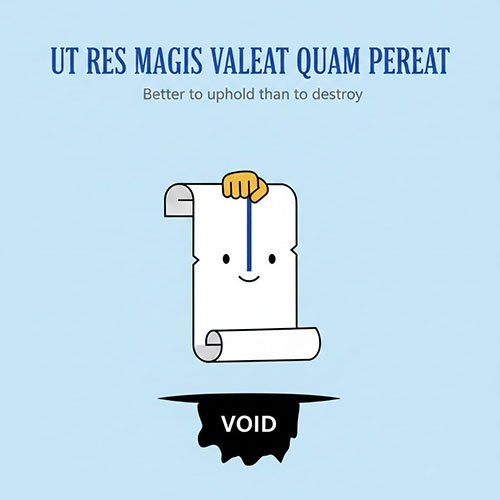
Interpretation of statutes is undertaken to give effect to the intention of the legislature. Courts always presume that the legislature does not enact a law in vain. One of the most important principles reflecting this approach is the maxim Ut res magis valeat quam pereat, which plays a crucial role in statutory and constitutional interpretation.
Meaning of the Maxim
The Latin maxim Ut res magis valeat quam pereat literally means:
“It is better for a thing to have effect than to be void or perish.”
In legal interpretation, it means that a statute must be interpreted in such a way that it operates effectively, rather than being rendered invalid, unworkable, or meaningless.
Explanation of the Rule-
According to this rule, where a statutory provision is capable of two or more interpretations, the court should prefer:
→The interpretation which upholds the validity of the statute, and
→The interpretation which gives the statute practical effect.
Courts must avoid interpretations that:
→Defeat the object of the law
→Render provisions nugatory or redundant
→Make the statute unconstitutional, if it can reasonably be avoided
This principle is closely linked with the presumption of constitutionality of statutes.
Object and Rationale of the Maxim-
→Respect for Legislative Wisdom
→The legislature is presumed not to enact meaningless or futile laws.
→Preservation of Law
→Courts should save a statute from invalidity whenever possible.
→Advancement of Legislative Purpose
→Interpretation should promote the object and spirit of the law.
→Judicial Restraint
→Courts should not lightly strike down laws if a valid interpretation is possible.
Application of the Maxim-
This maxim is widely applied in:
→Constitutional interpretation
→Taxation statutes
→Welfare and social legislation
→Delegated legislation
→Procedural laws
Courts often use techniques like:
→Reading down
→Harmonious construction
→Restrictive interpretation
to apply this principle.
Relationship with Constitutional Interpretation-
In constitutional matters, courts often interpret statutes in a manner that makes them consistent with fundamental rights, instead of declaring them unconstitutional. This approach directly flows from Ut res magis valeat quam pereat.
Reference Cases-
Kedar Nath Singh v. State of Bihar (1962)
The Supreme Court interpreted Section 124A (sedition) narrowly so that it applies only to acts involving violence or intention to create public disorder. This interpretation was adopted to save the constitutionality of the provision.
Tinsukhia Electric Supply Co. Ltd. v. State of Assam (1989)
The Court held that if a statute is capable of two interpretations, the one that sustains the law and makes it workable should be adopted.
CIT v. Hindustan Bulk Carriers (2003)
The Supreme Court ruled that interpretation must be such that it advances the object of the statute and avoids absurd or unworkable results.
State of Bihar v. Bihar Distillery Ltd. (1997)
The Court emphasized that statutory provisions should not be interpreted in a manner that makes them ineffective or meaningless.
Raj Krishna Bose v. Binod Kanungo (1954)
The Supreme Court preferred an interpretation that preserved the validity of election laws, rather than striking them down.
Delhi Transport Corporation v. DTC Mazdoor Congress (1991)
The Court read down arbitrary service rules to save them from unconstitutionality, applying the principle that law should operate rather than perish.
Charanjit Lal Chowdhury v. Union of India (1951)
The Supreme Court upheld the validity of legislation by adopting a construction consistent with constitutional provisions.
Limitations of the Maxim-
→Courts cannot rewrite legislation in the guise of interpretation.
→If the language is clear and unambiguous, the maxim cannot be used to distort meaning.
→It cannot save a statute that is clearly unconstitutional.
→Judicial creativity must not cross into legislative function.
Critical Evaluation-
The maxim ensures judicial respect for legislative intent, but excessive use may lead to judicial overreach. Hence, courts must apply it cautiously, balancing constitutional supremacy with legislative autonomy.
The maxim Ut res magis valeat quam pereat is a cornerstone of statutory interpretation. It ensures that laws enacted by the legislature are:
→Given meaningful effect
→Preserved from unnecessary invalidation
→Interpreted in a manner that advances justice and legislative purpose
Thus, this principle strengthens the stability, continuity, and effectiveness of the legal system.

we believe in a holistic approach to legal education building not just lawyers, but socially conscious leaders of tomorrow.
