Rules of Construction of Penal Statutes in India
TANMOY MUKHERJI INSTITUTE OF JURIDICAL SCIENCE
Dr. Tanmoy Mukherji
Advocate
Rules of Construction of Penal Statutes in India-
Tanmoy Mukherji
Advocate
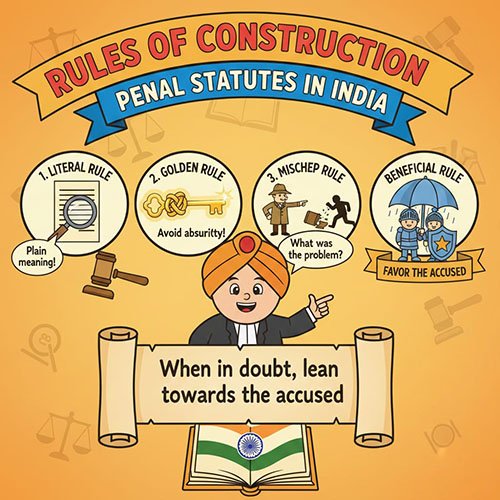
A penal statute is one that creates an offence or prescribes a punishment for its violation. Because penal laws affect personal liberty and other fundamental rights, they are interpreted with special caution.
Basic maxim:
“Nullum crimen, nulla poena sine lege” — No crime, no punishment without law.
Strict Construction (Literal Rule)-
Principle-
→Penal statutes must be construed strictly and narrowly.
→Courts cannot extend the scope of a penal provision by analogy, implication, or inference.
→The language must be given its ordinary, natural meaning.
Rationale-
→Protects individual liberty and prevents judicial law?making.
→Ensures certainty and predictability in criminal law.
Reference Case-
Tolaram Relumal v. State of Bombay AIR 1954 SC 496– If two interpretations are possible, the one favoring the accused should be adopted.
State of Maharashtra v. M.H. George (AIR 1965 SC 722) – Strict construction applies only when ambiguity exists; clear words must be given effect.
Rule of Lenity / Benefit of Doubt-
Principle-
→Ambiguity in penal law must be resolved in favour of the accused.
→If two constructions are possible, the one that exempts the accused from liability should be chosen.
Reference Cases-
Tolaram Relumal (1954) – Established the rule in Indian context.
R. v. Judge of City of London Court (1892) – English case illustrating narrow construction.
No Retrospective Operation-
Principle
Penal statutes are presumed to operate prospectively, unless the legislature clearly indicates retrospective effect.
→Article 20(1), Indian Constitution: No person shall be convicted of any offence which was not an offence when committed. (Fundamental right)
Reference. Case-
Keshavan Madhava Menon v. State of Bombay – Penal statutes are prospective unless expressed otherwise.
Presumption of Mens Rea (Guilty Mind)
Principle
Unless a statute expressly excludes mens rea, it is presumed that the legislature intended to require a guilty intention for criminal liability.
Reference. Case
Sweet v. Parsley (1970) – English case affirming presumption of mens rea; conviction quashed due to lack of mental intent.
State of Maharashtra v. Mayer Hans George (1965) – Indian presumption that mens rea is part of offence unless excluded.
Exception-
Some offences impose strict liability — mens rea not required.
Ranjit D. Udeshi v. State of Maharashtra (1965) – IPC sec. 292 (obscenity) held to impose strict liability (no mens rea needed).
Expressio Unius Est Exclusio Alterius-
Principle
→Express mention of specific items excludes other items not mentioned.
→Applied in cases where lists of prohibited acts or articles are clearly enumerated.
No Extension by Analogy / Implication-
Principle-
Courts cannot create an offence by broad interpretation or analogy to cover acts not expressly stated.
Reference. Case-
R. v. Harris (1836) – Penal statute interpreted literally to avoid expanding offence beyond clear words.
Literal Rule / Plain Meaning Rule-
Principle
Words used in penal statutes are given their ordinary meaning, even if this leads to acquittal.
Illustration
If the statute uses the word “vehicle” and two meanings are possible, the interpretation that strictly fits the offence must be adopted, otherwise the accused cannot be convicted.
Purposeful Interpretation / Modern Approach-
Principle
Although strict construction is basic, courts will interpret provisions in light of purpose when language is clear and legislative intent is plain.
Reference. Case
State of Maharashtra v. Tapas D. Neogy (1999) – Recognised strict interpretation but also upheld giving effect to legislative purpose where clear.
Penal Provisions in Special/Welfare Legislations-
In some modern social legislation (e.g., environment, labour), courts may interpret penal provisions liberally to give effect to the social purpose, provided such interpretation does not stretch language beyond clear legislative intent.
Constitutional Safeguards & Penal Law Interpretation
Article 21 (Right to Life and Liberty)
Penal statutes must be interpreted in consonance with fairness and reasonableness under Article 21, ensuring no arbitrary deprivation of liberty.
Example
Courts may interpret procedural penal provisions to ensure accused’s rights are protected.
Impact of Judicial Decisions Striking Down Penal Provisions
Joseph Shine v. Union of India (2018)
SC struck down Section 497 IPC (adultery) as unconstitutional, showing penal statutes can be voided where they violate constitutional principles.
→Penal statutes are interpreted with a balance between strict words and legislative intent, protecting individual liberty while giving effect to clear legislative purpose.

we believe in a holistic approach to legal education building not just lawyers, but socially conscious leaders of tomorrow.
