The Relationship between the American President and the U.S. Cabinet
Dr. Tanmoy Mukherji
Advocate
The Relationship between the American President and the U.S. Cabinet-
Tanmoy Mukherji
Advocate
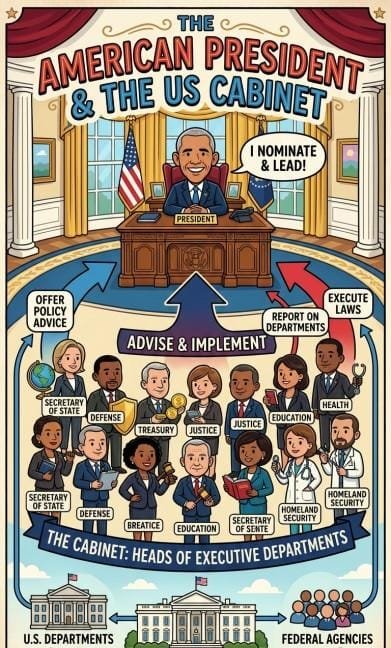
The relationship between the American President and the U.S. Cabinet is a key feature of the American presidential system. Unlike the parliamentary system, the Cabinet in the United States is not collectively responsible to the legislature but functions mainly as an advisory body to the President. The President is the real executive authority, while the Cabinet members act as his subordinates and advisers.
Composition of the U.S. Cabinet
The U.S. Cabinet consists of the heads of major executive departments such as:
→Secretary of State
→Secretary of Defense
→Secretary of Treasury
→Attorney General, etc.
Cabinet members are:
→Appointed by the President
→Confirmed by the Senate
→Responsible only to the President
Nature of the Relationship between the President and the Cabinet
1. President as Chief Executive
The President is the real executive head of the state and government. All executive powers are vested in him under the U.S. Constitution. Cabinet members merely assist him in carrying out executive functions.
2. Cabinet as an Advisory Body
The U.S. Cabinet has no constitutional status as a collective body.
It meets at the discretion of the President
It gives advice, but the President is not bound by it
The President may accept or reject Cabinet advice
Thus, the Cabinet is more of a consultative council than a decision-making body.
3. No Collective Responsibility
Unlike the British Cabinet system:
→The U.S. Cabinet does not follow collective responsibility
→Each Secretary is individually responsible to the President
→Cabinet members may openly disagree with each other and even with the President
4. President’s Power of Appointment and Removal
The President has:
→Power to appoint Cabinet members (with Senate approval)
→Power to remove them at will
→This power strengthens the President’s control over the Cabinet and makes Cabinet members politically dependent on him.
5. Cabinet Members Cannot Be Legislators
→Cabinet members are not members of Congress
→They cannot participate in congressional debates
→This creates a strict separation of powers
→As a result, Cabinet members act as administrators rather than political leaders.
6. President Dominates Policy-Making
Although Cabinet Secretaries are experts in their departments:
→Major policy decisions are taken by the President
→The Cabinet has little independent influence
→The President may rely more on the White House staff and advisors than the Cabinet
7. Cabinet Compared to the British System
|
USA
|
UK
|
|
President dominates Cabinet
|
Cabinet dominates Prime Minister
|
|
No collective responsibility
|
Collective responsibility
|
|
Cabinet not responsible to legislature
|
Cabinet responsible to Parliament
|
Evaluation
The relationship between the President and the Cabinet reflects the presidential form of government, where:
→Power is centralized in the President
→The Cabinet acts as a group of advisers and administrators
→There is no fusion of executive and legislature.
In conclusion, the relationship between the American President and the U.S. Cabinet is one of superiority and subordination. The President is the real executive authority, while the Cabinet functions mainly as an advisory and administrative body. This relationship highlights the fundamental difference between the American presidential system and the British parliamentary system.

we believe in a holistic approach to legal education building not just lawyers, but socially conscious leaders of tomorrow.
