REDEMPTION OF MORTGAGE
Transfer of Property Act, 1882
Dr. Tanmoy Mukherji
Advocate
REDEMPTION OF MORTGAGE-
Tanmoy Mukherji
Advocate
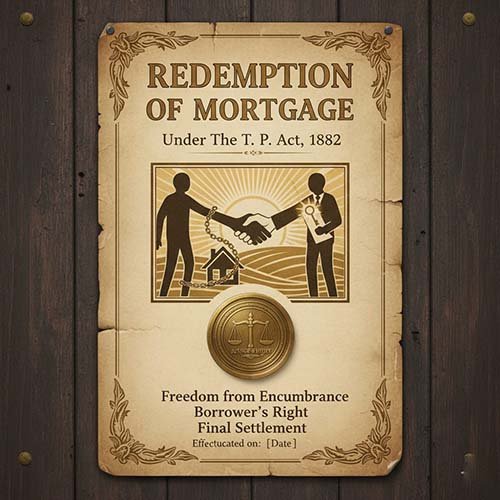
-Mortgagor's Right of Redemption or Doctrine of Equitable Redemption or Once a Mortgage always a mortgage and nothing but a mortgage.
-Among the rights of mortgagor, the right of redemption is of great importance. Section 60 of the Transfer of Property Act, 1882 confers on mortgagor, right to redeem. It means 'right to take back the mortgaged property from the mortgagee by repaying the mortgage money within the stipulated period of time. Section 60 runs as follows:
-At any time after the principal money has become due, the mortgagor has a right, on payment or tender, at a proper time and place, of the mortgage money, to require the mortgagee—
(a) To deliver the mortgagor the mortgage deed and all documents relating to the mortgaged property which are in the possession or power of the mortgagee;
(b) Where the mortgagee is in, possession of the mortgaged property, to deliver possession thereof to the mortgagor; and
(c) At the cost of the mortgagor either to retransfer the mortgaged property to him or to such third person as he may direct, or to execute and (where the mortgage has been effected by a registered instrument) to have registered an acknowledgment in writing that any right in derogation of his interest transferred to the mortgagee has been extinguished.
-Provided that the right conferred by this section has not been extinguished by act of the parties or by decree of the Court.
-The right conferred by this section is called a right to redeem, and a suit to enforce it is called a suit for redemption.
-Nothing in this section shall be deemed to render invalid any provision to the effect that, if the time fixed for payment of the principal money has been allowed to pass or no such time has been fixed, the mortgagee shall be entitled to reasonable notice before payment or tender of such money.
Redemption of portion of mortgaged property-
Nothing in this section shall entitle a person interested in a share only of the mortgaged property to redeem his own share only, on payment of a proportionate part of the amount remaining due on the mortgage, except only where a mortgagee, or, if there are more mortgagees than one, all such mortgagees, has or have acquired, in whole or in part, the share of a mortgagor.
Redemption of Mortgage-
The expression 'Redeem' means "Repurchase". In mortgage, it means 'paying off the mortgage money to get back the mortgaged property'. This right of mortgagor against mortgagee is called 'Right of Redemption' or 'Doctrine of Equitable Redemption'.
-In England, this right of redemption is available to the mortgagor for stipulated period under common law. But in the Courts of equity, this right is not lost after the stipulated period. There is no such distinction in Indian Law. Section 60 of the T.P.Act confers statutory right on the mortgagor to redeem the property even after the expiry of the stipulated period.
-The right of redemption is a statutory right, and the parties are prohibited to put any condition, which takes away this right.
Exceptions-
The right of redemption may be extinguished under the following cases-
(1) By act of parties.
(2) By operation of law; and
(3) By decree of the Court.
Once a mortgage always a mortgage and nothing but a mortgage-
The view 'Once a mortgage always a mortgage and nothing but a mortgage' was enunciated by House of Lords in a leading case
Noakes vs. Rice (1902) AC 24-
- In this case, Lord Devay supplemented (added) the words 'and nothing but a mortgage' to a well-known maxim 'Once a mortgage always a mortgage'.
-As stated above, the right of redemption is a statutory right conferred on the mortgagor under Section 60 of the T.P.Act. This statutory and permanent right of mortgagor gives rise to a well-known maxim 'Once a mortgage always a mortgage'. It means once mortgage deed is entered into, it can never be changed because change, if any, affects the right of redemption. Lord Devay supplemented (added) the words 'and nothing but a mortgage' in the leading case.
The above view was laid down by House of Lords through Lord Devay in-
Noakes vs. Rice (1902) AC 24-
In the instant case, Rice mortgaged his premises and goodwill to Noakes & Company, subject to recovery of the premises against the repayment of all the money with interest. There was a covenant in the mortgage deed that during the term, Rice shall not use or sell upon the premises, any malt liquors, not exclusively obtained by Noakes & Company. Held that Rice was entitled to redemption. Since, the covenant was a clog, on the equity of redemption, it was declared void.
On appeal, the House of Lords confirmed this view and laid down the following three principles-
(1) Once mortgage is always a mortgage. Mortgage cannot be made irredeemable and provision if any to that effect is void.
(2) The Mortgagee shall not reserve to himself any collateral advantages outside the mortgage contract; and
(3) Any stipulation restraining or preventing the mortgagor's right of redemption is void.
In other words, there should be no clog or fetter on the equity of redemption. Any stipulation which makes mortgage transaction inconsistent with the right of redemption is called 'Clog on Redemption'.
-The right of redemption is not only a statutory right recognised under Section 60 of the T.P.Act, 1882, but also equitable right since it is available to the mortgagor even after the expiry of the stipulated period for payment of the mortgage money. Right of redemption is an indefeasible right given to the mortgagor and it cannot be separated from Mortgage. Any agreement, which takes away this right, is an oppressive bargain and is void. An agreement conferring collateral benefit on the mortgagee also amounts to clog on redemption. It has been decided in Noakes & Company vs. Rice, 1914 AC 75.
-However, in
Kreglinger vs. New Patagonia Meat Cold Storage Company-
It was decided that collateral advantages can be enforced against the mortgagor provided there is nothing unreasonable about them.
-In this case a mortgage was executed in 1910 by a meat purchasing company in favour of a firm of wool brokers wherein, the mortgagee stipulated that for five years the mortgagor company should not sell sheep skins to any one other than the mortgagee so long as they were willing to pay at the market price. The loan could be paid off at any time. It was paid off in 1911. The Court held that collateral advantages could be enforced even after redemption, provided these conditions were satisfied-
(1) That it is not unfair and unconscionable;
(2) That it is not the nature of penalty to clog the equity of redemption;
(3) That it is not inconsistent or repugnant to the equity of redemption.
Application of Kreglinger’s Rule in India-
Section 60 of the Act invalidated the Kreglinger’s rule and hence it has no application in India. If any stipulation operated beyond redemption, it is void.
Instances of Clog on Redemption-
The following are the instances of clog on redemption-
(1) A condition of sale in default.
(2) A condition restraining the alienation during mortgage.
(3) A condition of long term for redemption.
(4) A condition postponing the redemption in case of default.
(5) Redemption restricted to the mortgagor.
(6) A condition to grant permanent lease to the mortgagee.
(7) Penalty in case of default; and
(8) An onerous condition extending beyond the redemption.
What is not Clog-
The following are not treated as Clog:
(1) Sale subsequent to the mortgage.
(2) High rate of interest.
(3) Remuneration to the mortgagee.
(4) Lease during mortgage.
(5) Right of pre-emption by mortgagee; and
(6) Condition for redemption of prior mortgagee.

we believe in a holistic approach to legal education building not just lawyers, but socially conscious leaders of tomorrow.
