The penalty provisions under the Trade Unions Act, 1926 with relevant case laws-
Dr. Tanmoy Mukherji
Advocate
The penalty provisions under the Trade Unions Act, 1926 with relevant case laws-
Tanmoy Mukherji
Advocate
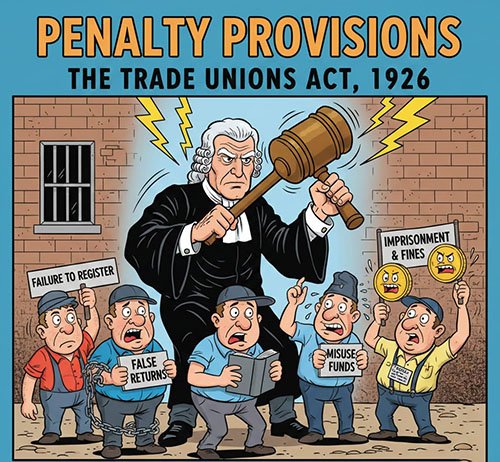
The Trade Unions Act, 1926 grants legal recognition and protection to trade unions. However, to ensure discipline, transparency and lawful functioning, the Act prescribes penal provisions for non-compliance. These penalties are mainly provided under Sections 31, 32, 33 and 33A of the Act.
Section 31 – Failure to submit returns-
Provision
Every registered trade union is required to submit:
→Annual returns,
→Statements of assets and liabilities,
→Changes in office-bearers, and
→Other prescribed documents to the Registrar.
Failure to comply attracts penal consequences.
Penalty
→Fine up to ?5 per week for default
→Maximum fine ?50
Liability extends to
→The trade union, and
→Every office-bearer responsible for the default.
Case Law
R. S. Ruikar v. Emperor (1935)
The court held that failure to submit statutory returns defeats the object of the Act, which is to ensure public accountability of trade unions. Hence, penalties under Section 31 are justified even though they are nominal.
Section 32 – False entries in returns-
Provision
If any person:
→Makes a false statement, or
→Willfully omits a material fact in any document or return submitted under the Act,
They commit an offence under Section 32.
Penalty
→Fine up to ?500
Case Law
Registrar of Trade Unions v. Raghubar Dayal (AIR 1957 All 412)
The Allahabad High Court held that intentional suppression or falsification of facts in union records amounts to an offence under Section 32, even if no financial loss is immediately shown.
Section 33 – Offences by members or office-bearers-
Provision
This section deals with:
→Misapplication or misuse of trade union funds,
→Acts done in violation of the Act or rules.
Penalty
→Fine up to ?500
Case Law
In re: Madras Labour Union (1949)
The court observed that union funds must be used strictly for purposes mentioned in Section 15 of the Act. Any deviation invites penal action under Section 33.
Section 33 – Cognizance of offences-
Provision
No court shall take cognizance of an offence under the Act except on a complaint made by or with the sanction of the appropriate government.
Object
→To prevent frivolous prosecutions, and
→To protect trade unions from unnecessary harassment.
Case Law
Chandramalai Estate v. Workmen (AIR 1960 SC 902)
The Supreme Court recognized that trade unions are instruments of collective bargaining and should not be exposed to reckless litigation without governmental scrutiny.
Nature and Philosophy of Penalties
Observations of Courts
Indian courts have consistently held that:
→Penalties under the Trade Unions Act are regulatory, not punitive.
→The intention is to ensure orderly administration, not to suppress trade union activities.
Case Law
All India Bank Employees’ Association v. National Industrial Tribunal (AIR 1962 SC 171)
The Supreme Court emphasized that trade unions enjoy statutory protection, but such protection is conditional upon compliance with legal obligations, including penalty provisions.
The penalty provisions under the Trade Unions Act, 1926 serve as a mechanism to:
→Ensure transparency,
→Prevent misuse of union funds,
→Maintain statutory discipline, and
→Balance workers’ freedom with legal accountability.
Although penalties are monetary and mild, they play a crucial role in strengthening the credibility and lawful functioning of trade unions in India.

we believe in a holistic approach to legal education building not just lawyers, but socially conscious leaders of tomorrow.
