Marxist Theory of Materialism (Historical Materialism)
Dr. Tanmoy Mukherji
Advocate
Marxist Theory of Materialism (Historical Materialism)-
Tanmoy Mukherji
Advocate
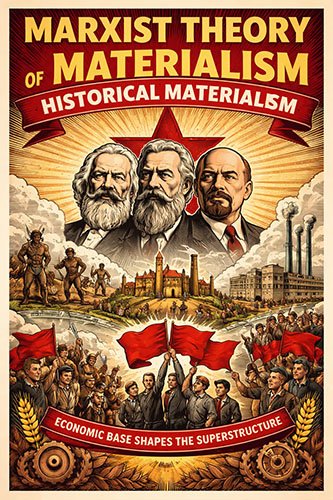
The Marxist theory of materialism, developed by Karl Marx and Friedrich Engels, is known as Historical Materialism. It explains social change, history, and social institutions on the basis of material (economic) conditions, rather than ideas, religion, or morality.
Marx famously stated:
“It is not the consciousness of men that determines their being, but their social being that determines their consciousness.”
Meaning of Materialism-
Materialism, in Marxist thought, means: The material conditions of life (economic structure) are the foundation of society.
Ideas, values, religion, law, and politics arise from economic relations.
Economic forces are the primary driving force of history.
Marx rejected idealism (e.g., Hegel), which viewed ideas as shaping reality.
Base and Superstructure-
Marx explained society through the concept of Base and Superstructure.
Economic Base-
The base consists of:
Forces of Production – land, labour, tools, technology.
Relations of Production – ownership and class relations.
Superstructure-
Includes:
→Law
→State
→Religion
→Morality
→Education
→Culture
The superstructure arises from and supports the economic base.
Modes of Production-
History progresses through different modes of production, each characterized by class relations-
→Primitive Communism – no class, common ownership
→Slavery – master and slave
→Feudalism – lord and serf
→Capitalism – bourgeoisie and proletariat
→Socialism – transitional stage
→Communism – classless society
Each mode contains internal contradictions leading to its collapse.
Class Struggle-
Class struggle is the engine of history.
“The history of all hitherto existing society is the history of class struggles.”
Capitalism produces conflict between:
→Bourgeoisie (owners of means of production)
→Proletariat (workers)
This struggle eventually leads to revolution.
Dialectical Materialism-
Marx adopted dialectics from Hegel but applied it to material conditions.
Three Laws of Dialectics:
→Unity and conflict of opposites
→Transformation of quantity into quality
→Negation of negation
Social change occurs through contradictions within material conditions.
Alienation-
Under capitalism, workers experience alienation:
→From the product of labour
→From the process of labour
→From their own human potential
→From other workers
Alienation results from private ownership of means of production.
Surplus Value and Exploitation-
Marx explained exploitation through surplus value:
Workers produce more value than they receive as wages.
The excess value is appropriated by capitalists as profit.
This exploitation is the root cause of inequality.
Ideology and False Consciousness-
The ruling class controls the dominant ideas of society.
Law, religion, and morality serve capitalist interests.
Workers develop false consciousness, accepting exploitation as natural.
Material conditions shape ideology.
Role of State and Law-
According to Marx:
The state is an instrument of class domination.
Law reflects the interests of the ruling class.
In communism, the state will “wither away.”
Criticism of Marxist Materialism-
→Overemphasis on economic factors (economic determinism)
→Neglect of culture, religion, and individual agency
→Prediction of capitalist collapse not fully realized
→Underestimates role of reform and welfare state
Importance and Influence-
Despite criticism, Marxist materialism:
→Influenced sociology, political theory, and economics
→Inspired socialist and communist movements
→Provided tools for analyzing inequality and power
Conclusion-
The Marxist theory of materialism presents history as a product of material conditions and class struggle. It offers a scientific explanation of social change and remains a powerful framework for understanding capitalism, inequality, and social transformation.

we believe in a holistic approach to legal education building not just lawyers, but socially conscious leaders of tomorrow.
