Essentials of Valid Contract
Indian Contract Act, 1872
TANMOY MUKHERJI INSTITUTE OF JURIDICAL SCIENCE
Dr. Tanmoy Mukherji
[Advocate]
ESSENTIALS OF VALID CONTRACT / ALL CONTRACTS ARE AGREEMENTS BUT ALL
AGREEMENTS ARE NOT CONTRACTS
Tanmoy Mukherji
[Advocate]
According to Sec.2 (h) of the Indian Contract Act, 1872 an agreement enforceable by law is a contract.
According to Sec.10 All agreements are contracts if they are made by the free consent of parties competent to contract, for a lawful consideration and with a lawful object, and are not hereby expressly declared to be void.
An agreement is considered as valid contract only when it meets all the necessary criteria. If certain factors are not fulfilled, it cannot be recognized as a valid contract.
The essentials of a valid contract are as follows, ----------
Two Parties: ---
There must be two parties for making a valid contract.
According to Sec 2 (a) of the Indian Contract Act,1872 When one person signifies to another his willingness to do or to abstain from doing anything, with a view to obtaining the assent of that other to such act or abstinence, he is said to make a "proposal"
According to Sec.4 the communication of a proposal is complete when it comes to the knowledge of the person to whom it is made.
According to Sec 2 (b) When the person to whom the proposal is made signifies his assent thereto, the proposal is said to be accepted. A proposal, when accepted, becomes a "promise"
According to Sec.4 The communication of an acceptance is complete, —
as against the proposer, when it is put in a course of transmission to him so as to be out of the power of the acceptor; as against the acceptor, when it comes to the knowledge of the proposer.
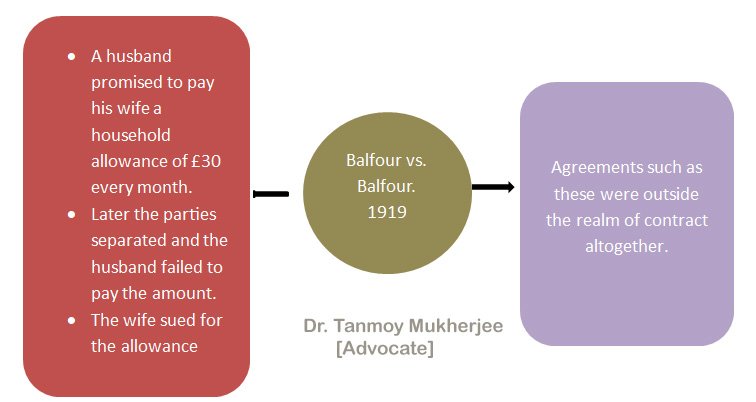
In case, there is no such intention on the part of parties, there is no contract.
Agreements of social or domestic nature do not contemplate legal relations.
Reference Case: - Balfour vs. Balfour (1919)
Sec.2 (e) says that every promise and every set of promises, forming the consideration for each other, is an agreement.
According to Sec. 2 (d) when, at the desire of the promisor, the promisee or any other person has done or abstained from doing, or does or abstains from doing, or promises to do or to abstain from doing, something, such act or abstinence or promise is called a consideration for the promise
According to Sec. 23 The consideration of an agreement is lawful, unless - it is forbidden by law; or
is of such a nature that, if permitted, it would defeat the provisions of any law; or is fraudulent; or involves or implies injury to the person or property of another, or the Court regards it as immoral or opposed to public policy.
According to Sec. 23 The object of an agreement is lawful, unless - it is forbidden by law; or
is of such a nature that, if permitted, it would defeat the provisions of any law; or is fraudulent; or involves or implies injury to the person or property of another, or the Court regards it as immoral or opposed to public policy.
According to Sec.2 (f) Promises which form the consideration or part of the consideration for each other, are called reciprocal promises.
According to Sec. 11 Every person is competent to contract who is of the age of majority according to the law to which he is subject and who is of sound mind and is not disqualified from contracting by any law to which he is subject.
Major: --- According to Sec.3 of the Indian Majority Act,1875 every person domiciled in India shall attain the age of majority on completion of 18 years and not before
Sound mind: ---According to Sec 12 a person is said to be of sound mind for the purpose of making a contract, if, at the time when he makes it, he is capable of understanding it and of forming a rational judgment as to its effect upon his interests.
A person who is usually of unsound mind, but occasionally of sound mind, may make a contract when he is of sound mind.
A person who is usually of sound mind, but occasionally of unsound mind, may not make a contract when he is of unsound mind.
Consent: -
According to Sec. 13 Two or more persons are said to consent when they agree upon the same thing in the same sense
According to Sec. 14 Consent is said to be free when it is not caused by—
1.coercion, as defined in section 15, or
2.undue influence, as defined in section 16, or
3.fraud, as defined in section 17, or
4.misrepresentation, as defined in section 18, or
5.mistake, subject to the provisions of sections 20, 21 and 22
Sec.26 - Sec.30 deal with those contracts which have been expressly declared void by the Indian Contract Act.
According to Sec. 29 Agreement the meaning of which is not Certain or capable of being made certain are void.
Possibility of Performance:---
According to Sec. 56 An agreement to do an act impossible in itself is void.
An oral Contract is a perfectly valid contract, except in those cases where writing, registration etc. is required by some statute. In India writing is required in cases of sale, mortgage, lease and gift of immovable property, negotiable instruments; memorandum and articles of association of a company, etc.
Registration is required in cases of documents coming within the scope of section 17 of the Registration Act 1908.
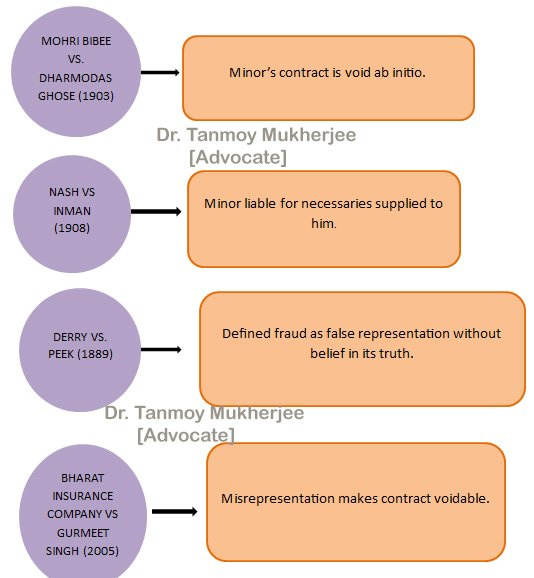
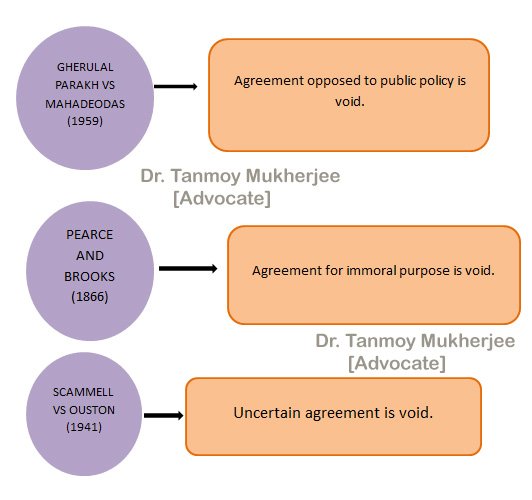
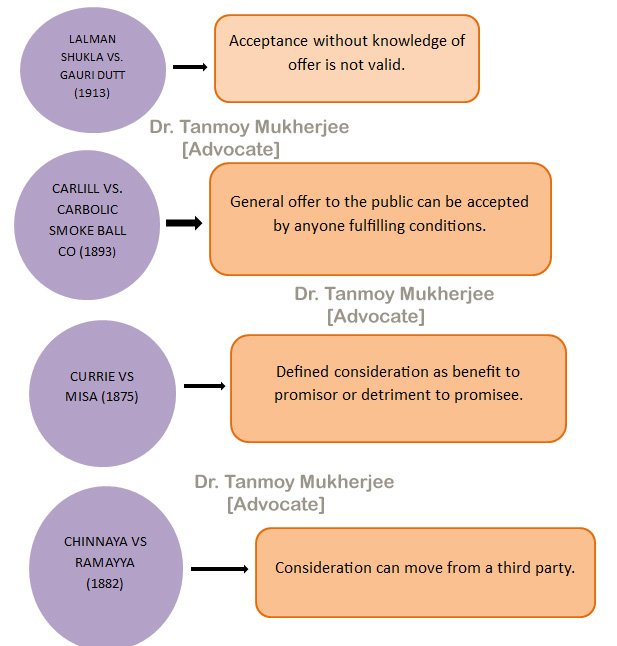
REFERENCE CASES-

we believe in a holistic approach to legal education building not just lawyers, but socially conscious leaders of tomorrow.