Difference Between Share and Stock
Dr. Tanmoy Mukherji
Advocate
Difference Between Share and Stock
Tanmoy Mukherji
Advocate
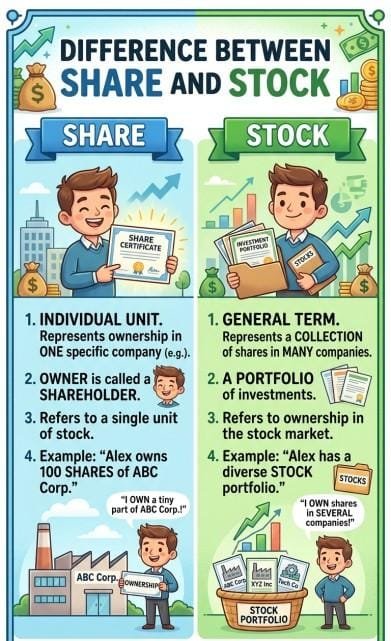
In Company Law, the terms Share and Stock are related but not identical. A share represents a specific unit of ownership in a company, while stock represents a collection of fully paid shares converted into a consolidated fund.
|
Basis |
Share |
Stock |
|
Meaning
|
A share is the smallest unit of share capital of a company. |
Stock is the aggregate of fully paid shares converted into one consolidated amount.
|
|
Definition
|
Defined under Section 2(84) of the Companies Act, 2013 as a share in the share capital of a company.
|
Not separately defined but recognized as converted fully paid-up shares.
|
|
Nature
|
Has a fixed nominal value (e.g., ?10 or ?100).
|
No nominal value; it represents a combined value of many shares.
|
|
Numbering
|
Each share has a distinct number.
|
No distinctive number.
|
|
Paid-up Status
|
Can be partly paid or fully paid.
|
Must always be fully paid-up.
|
|
Transfer
|
Transferred as a whole unit only.
|
Can be transferred in fractions (e.g., ?200 out of ?1000 stock).
|
|
Issue
|
A company issues shares directly to investors.
|
A company cannot issue stock directly; shares must first be issued and then converted into stock by resolution.
|
|
Original Issue
|
Original issue is possible.
|
Original issue is not possible.
|
|
Denomination
|
Always in fixed denominations (?10 share, ?100 share).
|
Any value portion can be transferred.
|
Example
If a company has 100 shares of ?10 each, it may convert them into ?1000 stock. After conversion, a shareholder can transfer ?150 stock, which is not possible with shares.

we believe in a holistic approach to legal education building not just lawyers, but socially conscious leaders of tomorrow.
