Difference between Court and Tribunal
Dr. Tanmoy Mukherji
Advocate
Difference between Court and Tribunal-
Tanmoy Mukherji
Advocate
|
Basis
|
Court
|
Tribunal
|
|
Meaning
|
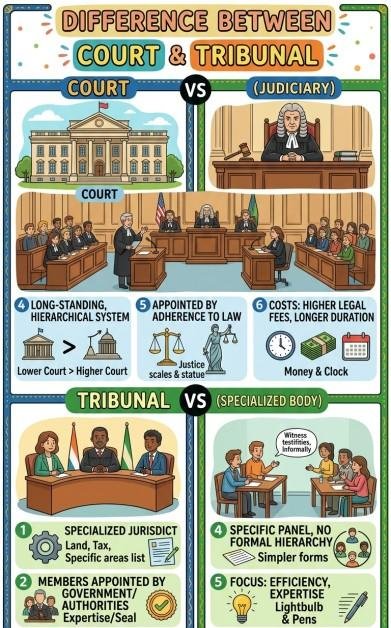
A Court is a judicial body established under the Constitution to administer justice in civil, criminal, constitutional matters. |
A tribunal is a quasi-judicial body created by statute to deal with specific types of disputes (like tax, administrative, service matters).
|
|
Scope of Power
|
Established under the Constitution of India (e.g., Supreme Court, High Court).
|
Created by Acts of Parliament or State Legislature.
|
|
Nature
|
Purely Judicial Body.
|
Quasi-Judicial Body (Combines Administrative & Judicial functions).
|
|
Union of India v. R. Gandhi→Tribunal must have characteristics similar to court, when relating them. |
||
|
Basis
|
Court
|
Tribunal
|
|
Procedure
|
Follows Strict Procedure like: → CPC → BNSS → BSA
|
Not Strictly bound by CPC or Sakshya Adhiniyam, follows principles of Natural Justice.
|
|
State of Mysore vs Shivabasappa → Tribunals are not bound by technical rules of evidence.
|
||
|
Basis
|
Court
|
Tribunal
|
|
Judges/Members
|
Judges are legally trained and qualified (Judicial officers)
|
Members may include Judicial members, Technical Experts, Administrative Experts. |
|
R. K. Jain v/s Union of India → Highlighted need for qualified members in tribunals.
|
||
|
Basis
|
Court
|
Tribunal
|
|
Scope of Jurisdiction
|
Has wide jurisdiction (civil, criminal, constitutional).
|
Has limited and specific jurisdiction (e.g., tax, service, company law).
|
|
Flexibility
|
Less flexible, bound by formalities.
|
More flexible, less formal.
|
|
Appeal
|
Appeals lie in Higher Courts.
|
Appeals may lie to appellate tribunals, or directly to High Court/Supreme Court.
|
|
Example
|
Supreme Court, High Court, District Court
|
National Green Tribunal (NGT), Income Tax Appellate Tribunal (ITAT), Central Administrative Tribunal (CAT), Securities Appellate Tribunal (SAT)
|
|
Independence
|
Enjoys complete Independence
|
Independence is comparatively weaker
|
|
Madras Bar Association v/s Union of India→Emphasized need for independence of tribunals similar to courts
|
|
|
|
Power of Judicial Review
|
Can exercise judicial review under Articles 32 & 226.
|
Cannot exercise full Judicial Review like Constitutional Courts. |
|
Chandra Kumar v/s Union of India→ Judicial Review is part of the basic structure. Tribunals are subject to High Court review. |
||
|
Binding Nature of Precedent
|
Bound by doctrine of Precedent (Stare Decisis)
|
Not strictly bound, but generally follows higher courts decisions. |
|
East India Commercial Co. Ltd. V/s Collection of Customs→ Lower authorities (including tribunals) must follow higher Court decisions.
|
||
|
Objective
|
General Justice Delivery
|
Specialized Justice + Speedy disposal in technical matters.
|
|
S.P. Sampath Kumar v/s Union of India→ Tribunals are created to reduce the burden of courts. |
||
|
Contempt Powers
|
Has inherent power to punish for Contempt.
|
limited or statutory contempt powers. |
|
T. Sudhakar Prasad v/s Govt. of A.P.→ Tribunals can exercise contempt powers if provided by Statute.
|
||

we believe in a holistic approach to legal education building not just lawyers, but socially conscious leaders of tomorrow.
